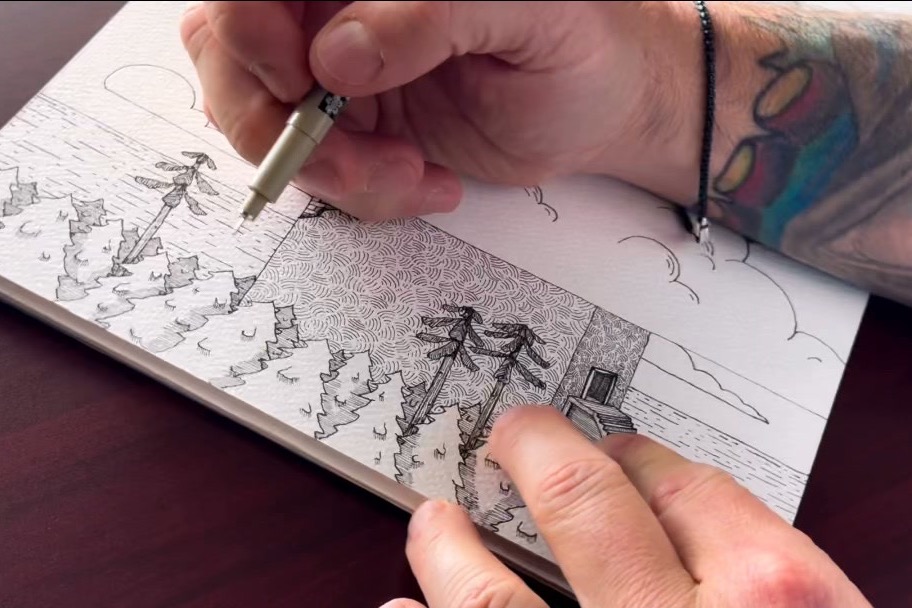
In an August 1 work-in-progress reel, I was deep into the part of a pen-and-ink drawing where the basic scene already existed, but it did not feel fully real yet. I spent that session building texture and shading into the structure, adding depth, age, and character one small section at a time.
A few hours of careful pen work changed the entire feeling of the drawing. The outlines did not move. The subject did not change. What changed was the amount of visual history inside the frame.
An outline explains what something is
Line work gives an image its basic information. This is a building. These are trees. This shape sits in front of that one. An outline can make the composition readable, but readability is only the beginning. Texture begins to suggest what the surfaces have been through, how the light reaches them, and whether the scene feels new, worn, quiet, heavy, or alive.
That is one of my favorite parts of the process. A wall stops being a flat shape and starts to feel as if it has stood there for years. A cluster of repeated marks becomes shadow. A darker edge pushes one plane forward while a quieter area gives the eye room to rest.
The detail is not there to prove how long it took. It is there to make the place feel lived in.
More detail is not automatically more depth
It would be easy to treat texture as filling every open space, but that usually makes the image harder to read. If every area receives the same weight and density, nothing feels important. Depth comes from contrast: dense marks beside open paper, heavy shadows beside thin lines, rough surfaces beside calm ones.
The decision is not simply where to add detail. It is where to stop. Each new group of marks has to support the structure that is already there. The goal is to guide attention through the image, not ask every inch of the page to compete for it.
I build the drawing in passes
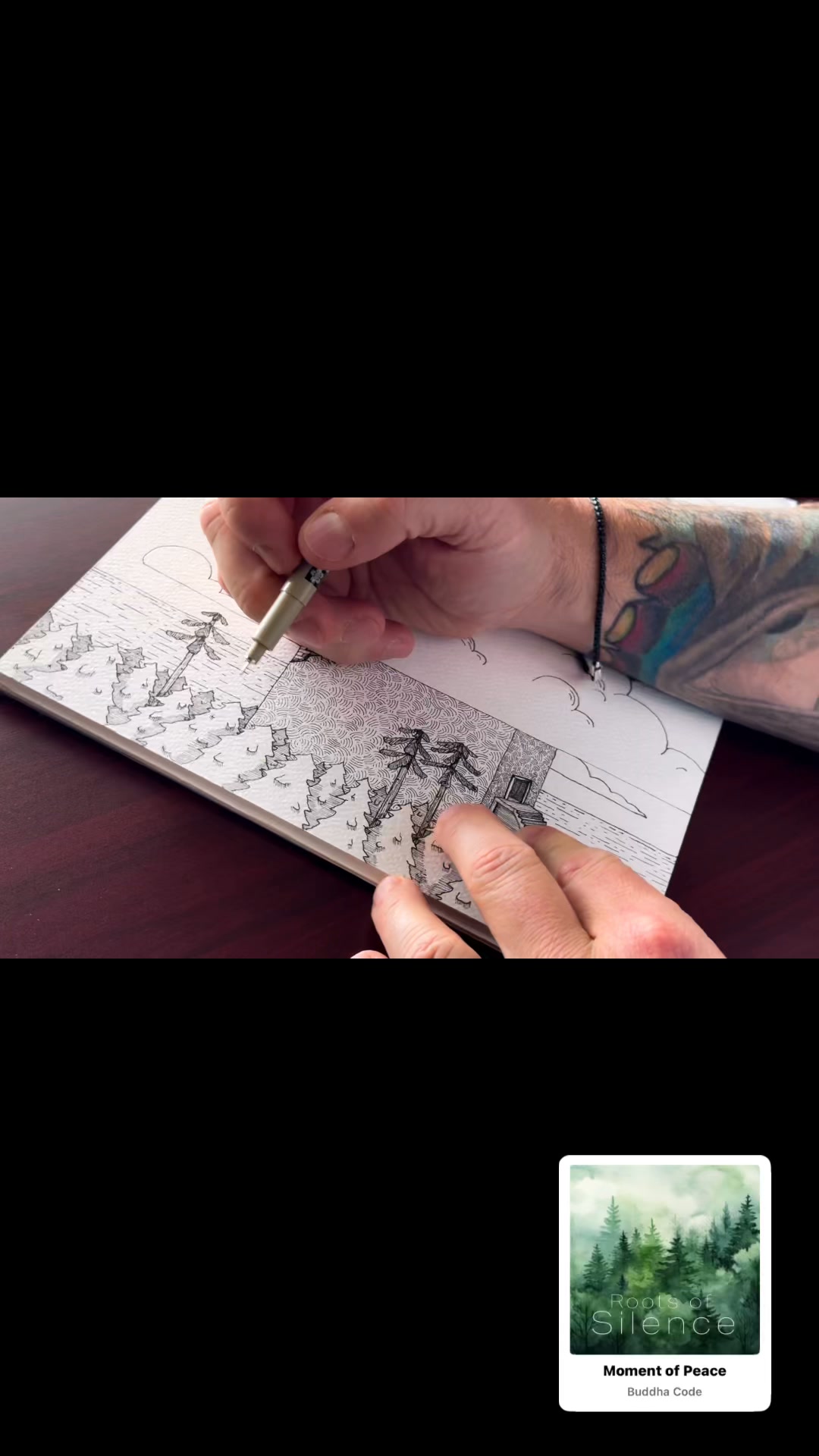
I do not need to solve every surface at once. I can establish the large forms, work through one texture, step back, and decide what the next area needs. That separation keeps the process manageable and lets the drawing develop without losing the larger composition.
Stepping back matters as much as leaning in. Up close, I am thinking about individual lines and patterns. From a distance, I am checking whether those marks become value, direction, atmosphere, and focus. The detail only works when it still belongs to the whole image.
The same principle applies in post-production
An early edit is a lot like the outline. It establishes the structure: what the audience sees, what comes next, and whether the message makes sense. The later passes create depth. Sound design can give an image weight. Motion can direct attention. Color can separate a subject from the background. A pause can make a line feel more important.
Those additions are useful only when they support the story. A transition should not call attention away from the idea. A sound effect should not fight the voiceover. Motion graphics should clarify information rather than turn every frame into a competition. Just as in the drawing, the strongest refinement comes from contrast and restraint.
Patience is part of the craft
Fast turnaround is a real part of professional creative work, and experience helps me make decisions quickly. That does not mean the work should feel rushed. Good systems create room for the deliberate passes that make a piece feel finished: checking the cut, refining animation curves, balancing sound, reviewing graphics, and preparing final versions.
The pen drawing makes that process visible because every mark remains on the page. There is no single dramatic step that suddenly creates the finished image. It changes through accumulation, correction, contrast, and the decision to keep working while the result is still only partially there.
A work in progress deserves to remain unfinished for a while
When I shared the reel, I said there was still more to do. That was not an apology. It was the point. The drawing was far enough along to show its direction, but open enough that the next session could still change how the world felt.
That middle stage can be uncomfortable because the work has moved beyond the initial idea without reaching the polish of the final piece. It is also where a lot of the real craft happens. The foundation is visible. The remaining job is to make every additional choice strengthen it.
You can see how I apply the same balance of structure, detail, and restraint across my video editing and motion-design work.