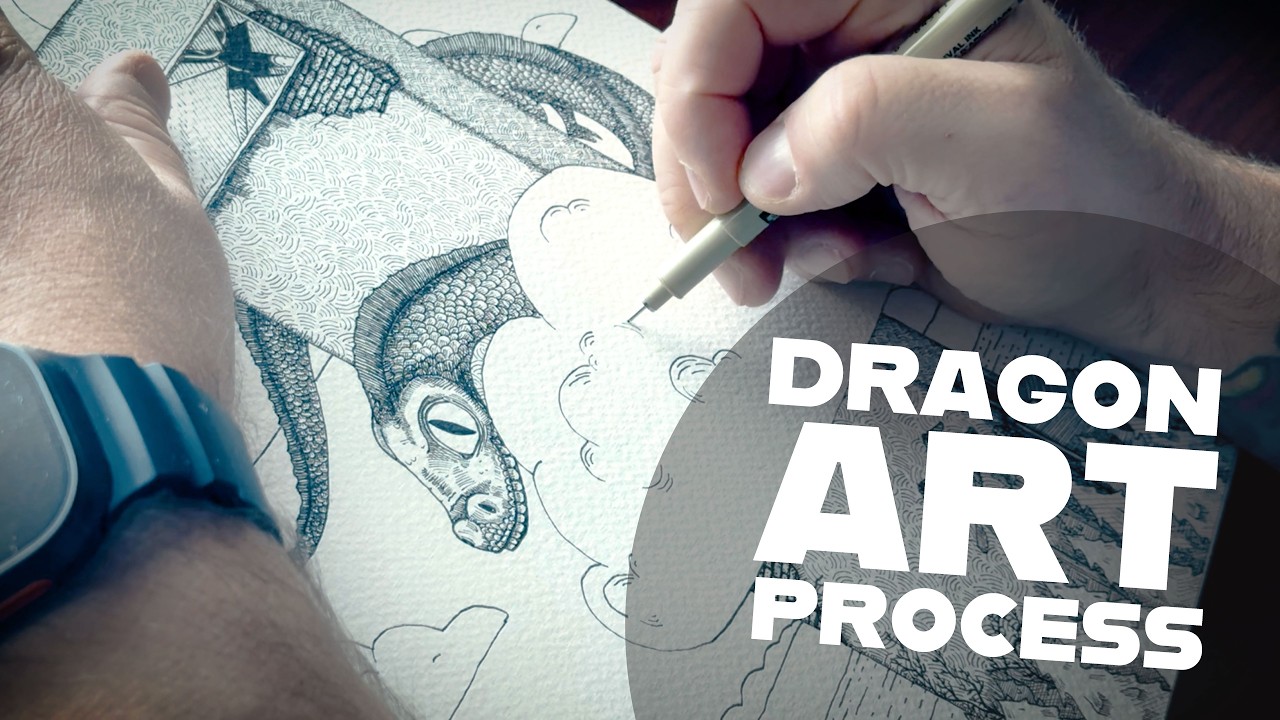
Drawing has always been an escape for me. When I settle into a piece, the outside noise gets quieter and the page becomes the only thing that matters. That is what I was trying to capture in my recent pen-and-ink dragon process video.
I described it as finding the flow and riding that current of creativity until the drawing is finished. I do not fight it. I let it carry me. That can sound like the work simply happens, but flow is not the absence of effort. It is what becomes possible after attention, repetition, and trust begin working together.
Escape means being fully present
When I say drawing is an escape, I do not mean avoiding the work. I mean entering it completely. The page creates a smaller world with a clear set of problems: where the next line belongs, how one texture should meet another, where the image needs weight, and where it needs space.
That narrowing of attention is the relief. I am not trying to solve everything at once. I am responding to the mark in front of me. One decision creates the next, and the drawing slowly becomes more specific.
Flow is not losing control. It is trusting the skills that let the next decision arrive.
The structure was already there
The finished image contains a lot of detail: scales, clouds, landscape shapes, repeated patterns, and the dragon moving through them. I did not have to hold every finished mark in my head at once. The larger forms gave me places to work, and the pen gave the image a consistent visual language.
Those boundaries matter. Flow is easier to find when the basic decisions are already made. The tool is chosen. The page has limits. The visual world has rules. Instead of spending energy reopening every possibility, I can concentrate on developing the idea that is already taking shape.
Repetition becomes momentum
A field of small marks can look slow from the outside. While I am drawing, repetition creates rhythm. A series of scales or curved cloud lines gives my hand a pattern to follow, but it is not automatic. Each mark still has to respond to the form around it.
That balance between repetition and adjustment is a large part of craft. Practice makes the motion familiar enough that attention can move to the larger question: Is this area becoming too heavy? Does the eye still reach the dragon? Does the texture describe the form or flatten it?
Flow does not remove editing
Following the work does not mean accepting every choice. I still need to step back, evaluate the whole image, and decide what should be strengthened or left alone. The energy of making and the discipline of reviewing are different modes, and both are necessary.
Stopping to judge every line would break the rhythm. Refusing to judge anything would leave the drawing without hierarchy. The useful cycle is to work closely, pull back, read the image, and return with a clearer sense of what it needs.
The same current exists in post-production
I recognize this feeling in editing and motion design. A project begins with structure: a message, footage, a script, a runtime, a brand system, and a delivery list. Once those boundaries are understood, the timeline becomes a place for focused decisions.
A cut suggests the next shot. A change in music reveals where motion should build. A graphic clarifies one idea and shows that another section needs less. Experience helps the technical actions recede so more attention can stay on rhythm, meaning, and the way the entire piece feels.
That is also why organization matters. Clean projects, dependable templates, and a clear version plan do not make the work less creative. They remove friction that can interrupt the current once it appears.
You cannot demand flow, but you can make room for it
Not every session feels effortless. Some drawings resist. Some edits need several versions before the real shape becomes visible. The goal is not to wait for inspiration to arrive in perfect form. It is to build a practice that makes sustained attention more likely.
For me, drawing provides that space in a direct way: paper, ink, one mark, then another. The dragon video records the result, but the real value is the time spent inside the process. That escape returns me to the same skills I use professionally: observation, patience, rhythm, selection, and finishing what I started.
You can see how those instincts carry into my video editing and motion-design work.