
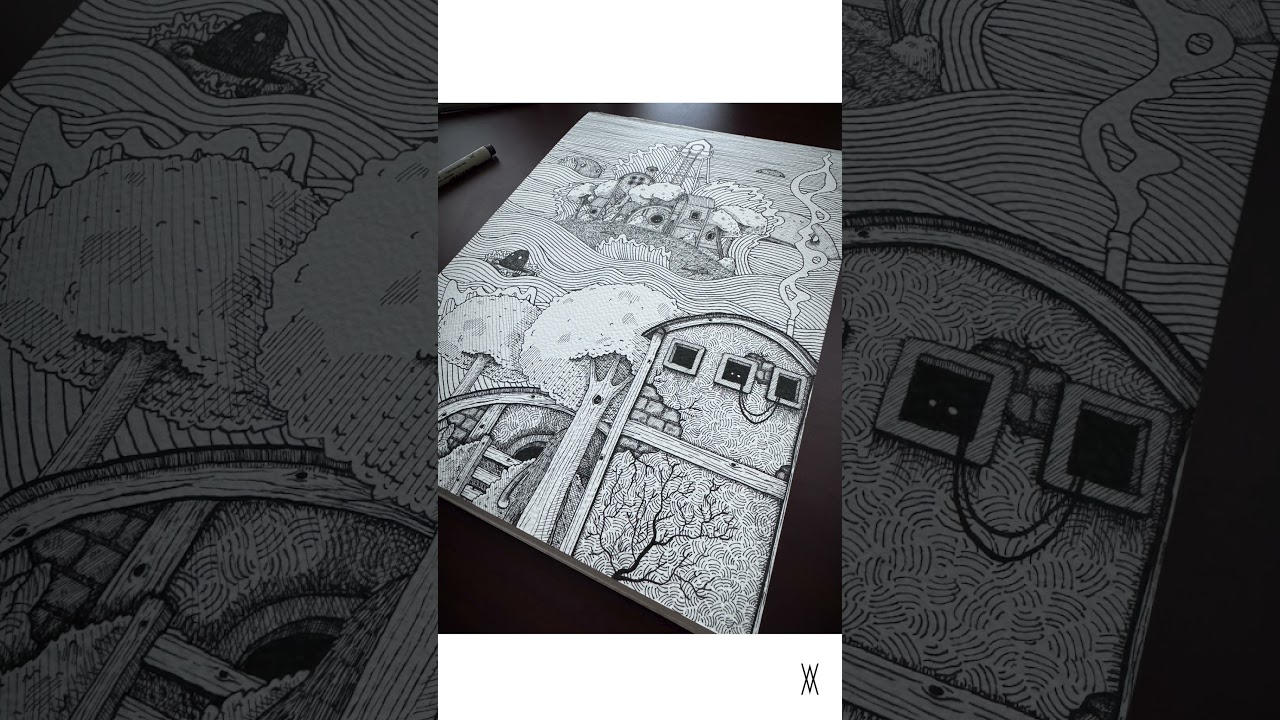
A couple of months ago, I shared a goal publicly: create 18 detailed pen-and-ink drawings and turn them into a book. Not quick sketches. Not ten minutes of drawing and moving on. I want to sit with each piece, finish it, and build a collection people can flip through, get lost in, or even color.
I am not announcing a finished book or pretending I have every detail solved. The goal is the useful part right now. It gives the drawings somewhere to go beyond the next post and asks me to think about them as a body of work instead of isolated pages.
One finished drawing proves one idea
A single drawing can succeed on its own terms. I can begin with a blank page, put down the first line, and follow the image as it develops. One recent piece slowly became a strange world filled with hidden creatures, unusual buildings, layered textures, and a mysterious watchtower.
I do not always know where these drawings are going when I start. That discovery is a large part of why I enjoy them. The first marks create a problem, the next marks answer it, and eventually the page develops its own logic.
A book asks each drawing to stand on its own and belong to something larger.
Eighteen drawings create a different creative problem
Once the goal becomes 18 pieces, finishing one page is no longer the entire job. The drawings need enough consistency to feel connected and enough variation to keep the collection interesting. Repeated line work can create a visual language, but repeated ideas can make the pages feel predictable.
That means paying attention to scale, density, subject, point of view, and the amount of open space from one drawing to the next. A crowded world may need a quieter page beside it. A large creature may be followed by a landscape or a smaller hidden moment. I am describing the questions the format raises, not a locked sequence I have already finalized.
The series creates accountability without removing discovery
A number gives the project a real edge. Eighteen is specific enough to measure and large enough that I cannot rely on the excitement of one new idea. I have to return to the page, keep working through the middle, and finish pieces even after the first burst of discovery has passed.
At the same time, I do not want the goal to turn every drawing into an assignment. The best part of the process is still not knowing exactly what will appear. The structure belongs around the practice: make the time, complete the page, preserve the finished work, and let the image itself remain open to surprise.
Finishing changes how I look at the next page
When a drawing is complete, I can see more than whether I like it. I can see which textures carried depth, where the eye moved, which repeated marks became too heavy, and which strange details made the world feel alive. That information follows me into the next piece.
This is why finishing matters. An unfinished idea can remain perfect in my head because it never has to survive the decisions required to make it real. A finished page gives me something honest to evaluate, learn from, and place beside the others.
A book gives the audience a different experience
Social posts are fast. Someone can stop, look, react, and keep moving. A book invites a slower kind of attention. The scale is physical. The pages create order. Details can be found on a second or third look, and one drawing can change how the next one feels.
That is especially suited to the way I draw. I like hiding small creatures, faces, buildings, patterns, and visual stories inside the larger composition. The first read establishes the world. The closer reads reward the person who stays with it.
The project uses the same muscles as post-production
The medium is different, but the larger process feels familiar. Editing and motion design also move between individual decisions and the complete piece. A cut can work by itself and still be wrong for the sequence. A graphic can look polished and still compete with the message. The strongest work depends on rhythm, hierarchy, contrast, continuity, and knowing when it is finished.
Building a collection adds another version of that challenge. Each drawing needs craft and personality. The book needs pacing and cohesion. Both require patience through the unglamorous middle, when the idea is no longer new and the final result is not visible yet.
The goal is to make the larger idea real
I set the goal because I want these drawings to become more than a folder of separate pieces. I want a finished object that reflects the time, line work, strange worlds, and repeated choice to keep going.
There is still work ahead, and I will let the collection evolve as the pages accumulate. For now, the direction is clear: make 18 drawings, finish them with care, and build something people can spend time exploring.
You can also see how that focus on story, pacing, detail, and finishing carries into my video editing and motion-design work.