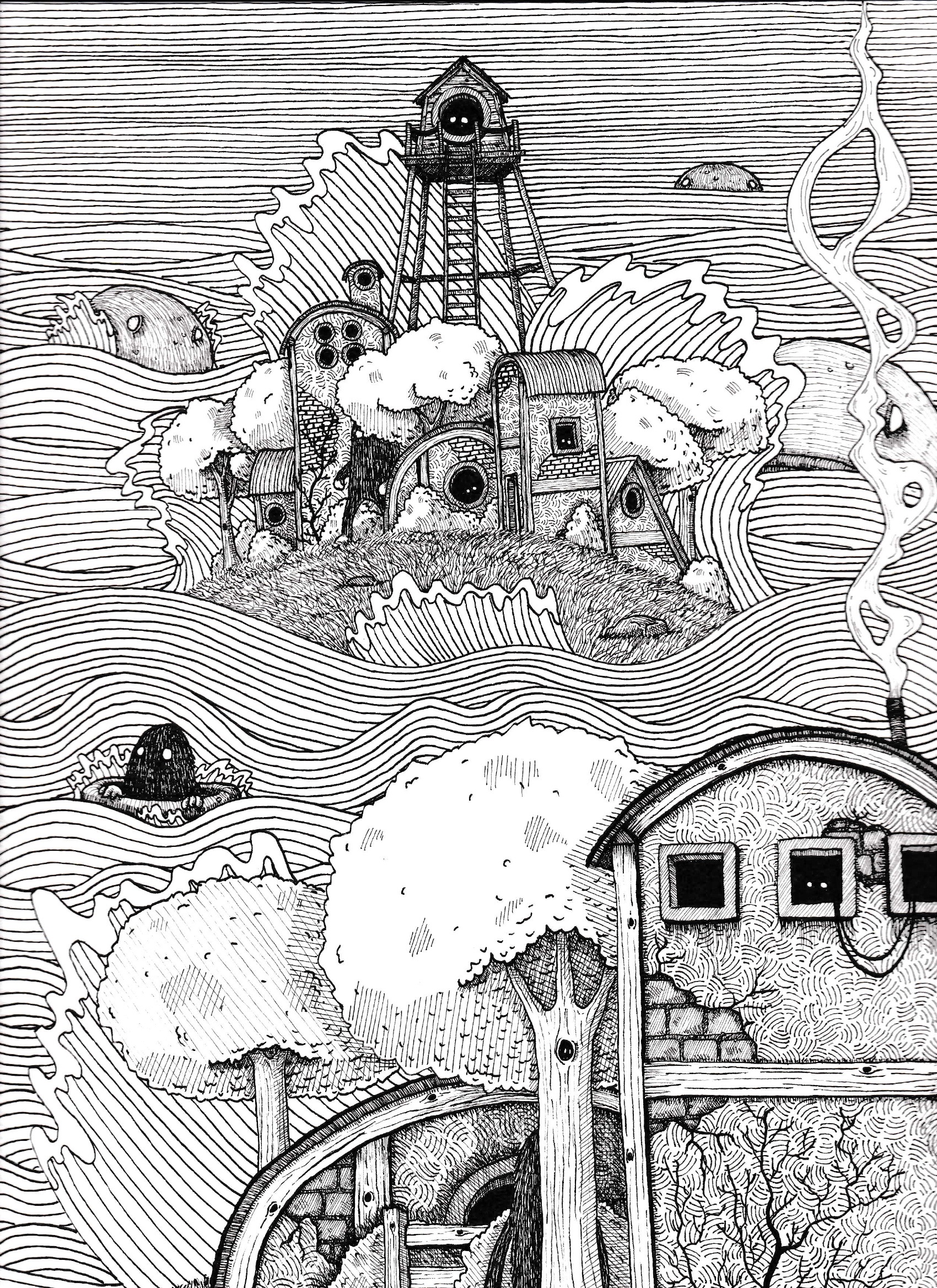
A recent pen-and-ink drawing started with a blank page and no fixed destination. One line became another. Hidden creatures appeared, then odd buildings, then a mysterious watchtower. I did not begin with a finished composition in my head. I put down the first line and watched the little world reveal itself.
That has been a recurring theme in the drawings I have shared lately. Another page started the same way and gradually filled with waves, sea creatures, smoke, ships, and small stories tucked into the details. I described it as feeling less like drawing and more like discovering something as it unfolds. That is still the best way I know to explain it.
The first line only needs to create the next decision
A blank page can feel like complete freedom, but complete freedom is not always helpful. The first line changes that. It gives the eye something to react to: a direction, a boundary, a shape that can be continued or interrupted. It does not have to solve the drawing. It only has to make the second line possible.
That is useful in any creative process. The first edit, first frame, or first rough storyboard does not need to carry the full weight of the finished piece. Its job is to create something specific enough to evaluate. Once there is a real choice in front of you, the work can begin answering back.
The first mark is not the answer. It is an invitation to make the next decision.
Constraints make discovery possible
Pen and ink create a simple set of rules. The marks are permanent. Value comes from line weight, spacing, texture, and the accumulation of detail. Those limitations do not remove options; they give the drawing a language. Every new shape has to belong to the marks already on the page.
Creative production works the same way. A script, runtime, aspect ratio, brand system, delivery list, or deadline can look like a restriction. Used well, it becomes a frame for better decisions. The goal is not to fight every constraint. It is to find the most interesting solution that still communicates clearly inside them.
Discovery still needs the discipline of finishing
Open-ended does not mean unfinished. A couple of months ago, I shared that I had returned to making detailed ink drawings and set a goal to complete 18 pieces for a book. The point was not a quick sketch or ten minutes of experimentation. It was to sit with each piece, keep adding to it, and see it through.
That commitment changes the exercise. The early stage is about possibility. The middle is where the idea gets complicated. The final stretch is where editing becomes important: deciding which areas need more detail, where the eye needs a place to rest, and when another mark would add less than it takes away. Finishing requires a different kind of creativity than starting, but both belong to the same process.
The connection to editing and motion design
A timeline may look more structured than a blank sheet of paper, but it develops through the same conversation between intention and discovery. A concept or script gives the work direction. The first assembly makes that direction visible. Then pacing, sound, motion, and transitions begin to reveal relationships that were difficult to see in the abstract.
The experienced part of the process is not knowing every answer before the work begins. It is knowing how to keep the exploration useful. That means protecting the core message, recognizing when an unexpected idea improves it, and maintaining enough organization that discovery does not become confusion. The work can evolve without losing its purpose.
Leave a little room for surprise
Tools are getting faster, and there is real value in removing repetitive work. But speed can also encourage us to decide what something is too early. An open-ended drawing is a good reminder that not every creative choice needs to be predicted before the first mark is made.
Sometimes the strongest idea is already hiding in the material. It takes a first line, a rough cut, or an imperfect frame to make it visible. The process still needs direction and a clear finish, but it also needs enough room for the work to surprise the person making it.
You can see how that balance between structure and discovery carries into my editing and motion work. You can also follow the newest drawings and process videos in my recent LinkedIn activity.