This October will be my seventh year doing Inktober. That still feels a little strange to say because I never started it as some long-term plan. I just wanted to draw more, work on my pen-and-ink skills, and give myself a reason to finish something every day.
Then I came back the next year. And the year after that. Somewhere along the way, it became something I look forward to and something I feel committed to finishing.
The timing is not exactly convenient. October falls right in the middle of one of the busiest parts of my editing year. Political work picks up from August through November, which means I can have a lot of projects, revisions, alternate cuts, deadlines, and final files moving at the same time. That is actually part of why I want to keep doing it.
A different kind of creative problem
Most of my professional work starts with a goal that is already defined. There is a script, a voiceover, a message, a deadline, and a list of versions that need to be delivered. Even when I have a lot of creative freedom, the finished piece still has a specific job to do.
Inktober is different. The prompt gives me a starting point, but the rest is open. I can take it literally, turn it into a visual joke, build a character around it, or use it as an excuse to draw a scene I would not have come up with otherwise.
That freedom changes the way I think. I am not trying to solve a client problem or hit a delivery spec. I am looking at one word and asking myself what I see in it.
The constraint helps me finish
A blank page can go in a hundred directions. A daily prompt narrows that down just enough to get me moving. I still have to decide on the idea, composition, line work, lettering, and how much detail the drawing needs, but I am not waiting around for the perfect idea.
The one-drawing-a-day structure also puts a limit on how long I can keep changing things. I have to make a choice, put ink on the page, and finish it. Some drawings are more successful than others. Some are simple. Some become much more detailed than I expected. They all count because the point is to keep showing up and complete the page in front of me.
That mindset carries back into editing. At some point, you have to stop looking at every possible version and commit to the cut that tells the story best. Finishing is part of the creative process.
Seven years makes the progress visible
One drawing does not always tell me much about how I am changing. A full month does. Seven years makes it even easier to see.
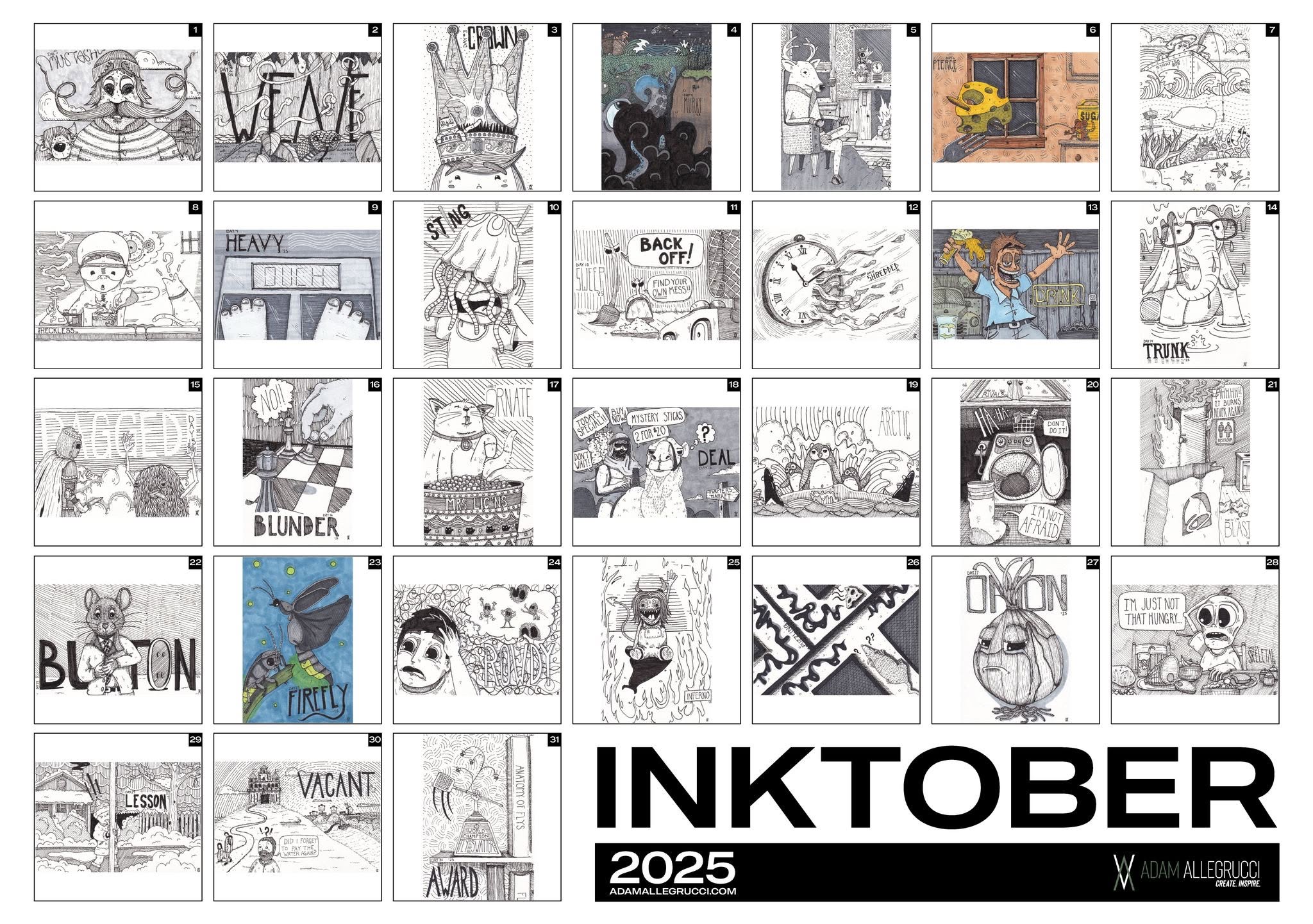
When I look back at the yearly sheets, I can see the way my line work, lettering, characters, visual jokes, and compositions have shifted. I can also see patterns that keep coming back. Strange creatures. Faces. Small stories hidden inside a prompt. Drawings that start with something ordinary and move somewhere unexpected.
I do not need every drawing to become a portfolio piece. The collection matters because it records the work. It shows the ideas that came easily, the ones I had to fight for, and the days when I found a way to finish even when I was busy.
Making room for work that is mine
During a heavy editing season, most of my creative energy can easily go toward deadlines and client work. I love editing, but I also need something that is mine. Drawing gives me a place to slow down, follow an idea one line at a time, and make something without worrying about formats, notes, approvals, or versions.
That does not mean every day will be easy. I already know there will be nights when I am tired and the last thing I feel like doing is starting another piece of work. The difference is that this work resets a different part of my brain.
I keep coming back because I like seeing what happens when I give myself the same basic challenge again. One prompt. One drawing. One day. Then do it again tomorrow.
What I want from year seven
I am not going into this year trying to completely reinvent the way I draw. I want to keep improving my pen-and-ink work, try ideas I might normally skip, and finish the month with another honest record of where I am creatively right now.
And I want to enjoy it. That part matters.
If you want to see more of the illustration and motion work that grows out of this kind of practice, you can take a look through my selected work. For now, I have another prompt waiting.